
Standing on the edge of the Atlantic at Bathsheba, the first thing that strikes you isn’t the surf, but the sentinels. Massive, top-heavy limestone monoliths rise from the churning foam like ancient sculptures. These are the Mushroom Rocks, the iconic visual signature of the St. Joseph coastline and a window into the violent, prehistoric birth of Barbados. While the Overview of Bathsheba highlights their aesthetic beauty, the underlying geology tells a story of tectonic upheaval and relentless maritime forces.
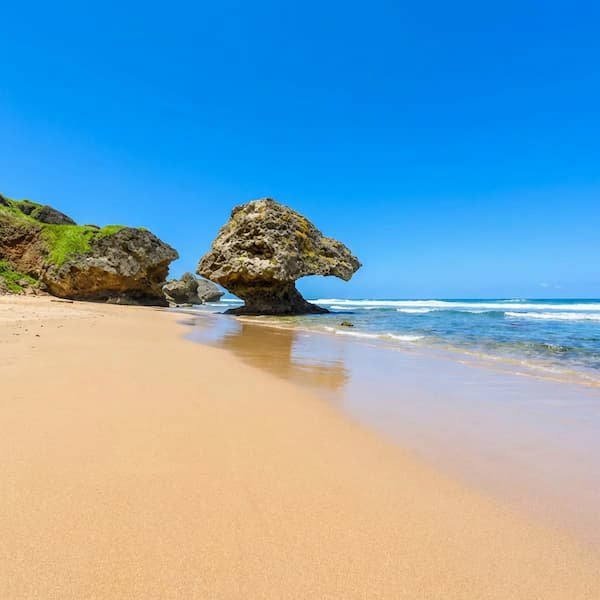
The Mushroom Rock Moniker
To the casual observer, these formations look intentionally carved. Their peculiar shape—a wide, heavy crown resting on a narrow, eroded neck—is the result of relentless Atlantic energy. This is a classic example of differential erosion. The salt spray and the high-tide line wear away the base of the coral limestone faster than the sun-hardened tops, which remain relatively protected from the constant mechanical grinding of the sea. Over centuries, this process creates the “stem” of the mushroom, eventually leading to a structural failure where the massive head topples into the surf.
A Geological Anomaly
Unlike its neighbours in the Lesser Antilles, Barbados is not a volcanic island. It is the subaerial peak of an accretionary prism. As the Atlantic plate slides beneath the Caribbean plate, seafloor sediments and coral are literally scraped off and thrust upward. This process, known as subduction, forced deep-ocean materials to the surface, creating a landmass dominated by sedimentary rock rather than basalt or andesite.
“Barbados is a geological outlier; while the West Coast offers calm Caribbean sands, the East Coast is a raw display of the earth’s crust being pushed from the deep ocean floor to the sky.”
The Foundation: Scotland Group Turbidites
Beneath the white coral limestone caps lies the “basement” of the island: the Scotland Group. These are turbidites—sedimentary deposits formed by ancient underwater landslides over 50 million years ago during the Eocene epoch. These layers of sandstones, shales, and clays are significantly softer than the limestone above. At Bathsheba, this unstable foundation contributes to the dramatic cliff collapses that have deposited these massive boulders onto the shoreline. The interaction between the rigid coral cap and the malleable Scotland Group is what makes the St. Joseph parish so prone to the “slumping” landscapes visible today.
The Scotland Group is a unique exposure of deep-sea sediments that are usually buried miles beneath the ocean floor, visible here only because of the intense tectonic uplift of the Barbados Ridge.
The Mechanism of Movement: Mud Diapirism
The movement of these rocks from the inland cliffs to the Atlantic waterline is driven by a process called mud diapirism. Specifically, the Joe’s River Formation—a layer composed of oil-impregnated, liquid-like mud—acts as a lubricant. Under immense geological pressure, this mud is forced upward through rock layers. This creates a geologically volatile environment where massive sections of the original reef terrace can “slide” toward the sea on a cushion of high-pressure mud. It is this tectonic conveyor belt that has populated the Soup Bowls area with such high concentrations of isolated limestone blocks.
| Feature | Geological Significance | Best Time for Photos |
|---|---|---|
| Mushroom Formations | Differential Atlantic Erosion & Bioerosion | Low Tide (reveals the narrow stems) |
| Scotland Group | Eocene-aged Basement Rock (50m years old) | Golden Hour (highlights sedimentary textures) |
| Coral Limestone | Upper Pleistocene Orbicella annularis | Mid-day (showcases brilliant white contrast) |
Composition and Erosion: The Scleractinian Core
The Mushroom Rocks are primarily composed of Lower Coral Rock, specifically the fossilised remains of Upper Pleistocene Orbicella annularis (formerly Montastraea annularis). These massive, star-shaped coral colonies provided the structural density required for the rocks to remain intact during their descent from the cliffs. However, they are not immune to the sea. The narrow “necks” of the rocks are further carved by intertidal bioerosion. Marine organisms, including mollusks, sponges, and sea urchins, graze on algae at the water line, chemically and mechanically carving a deep notch into the limestone base.
Supplementing this biological activity is the mechanical abrasion caused by “Atlantic Rollers.” These high-energy waves, which travel thousands of miles across the open ocean, carry suspended sand and pebbles. This mixture acts as high-grade sandpaper, grinding away the base of the rock more rapidly than the top, which sits above the primary splash zone. For those visiting to document these features, checking the Atlantic Tides Guide is vital, as high tide often obscures the most dramatic erosion notches.
Nearby Attraction: Andromeda Botanic Gardens
Located about half a mile inland from the Mushroom Rocks, Andromeda Botanic Gardens offers a stark contrast to the salt-battered coast. Founded in 1954 by Iris Bannochie, the leading expert on Caribbean flora of her time, the garden is a masterclass in tropical horticulture. Bannochie was awarded the Veitch Memorial Medal by the Royal Horticultural Society (RHS) for her contributions, and today, Andromeda remains the only garden in the Caribbean to be an International Partner Garden of the RHS. The garden spans six acres and is open daily from 10:00 AM to 4:00 PM (2026 admission is $30 BBD per adult).
The garden’s name is a poetic nod to Greek mythology; Andromeda was chained to a rock, mirroring how the garden is anchored to the limestone cliffs overlooking the Atlantic. Visitors can observe one of the largest and oldest Bearded Fig Trees (Ficus citrifolia) on the island. This specific species, with its aerial roots resembling a beard, inspired Portuguese explorers to name the island “Los Barbados” (The Bearded Ones). Utilizing the natural runoff and stream systems of the St. Joseph highlands, the garden hosts over 600 species, providing a lush micro-ecosystem that thrives in the humid, spray-misted air of the East Coast.